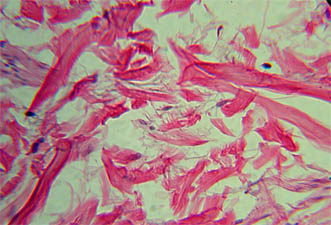
|
A.
|
B.
|
|
C.
|
D.
|
|
E.
|
F.
|
|
G.
I.
|
H.
|
Download Printable Version
Lab 7: Connective Tissue
PURPOSE:
To review the characteristics of connective tissue and to observe examples of the major types of this tissue
LEARNING OBJECTIVES:
1. Describe the general characteristics of connective tissue
2. List the three major types of connective tissues and their characteristics
3. Name and describe the special characteristics of each of the six types of connective tissues (non-cartilage)
4. Name three types of cartilage and explain their differences
5. Identify the major types of connective tissue on microscope slides
PROCEDURE:
1. Review Cpt 4, pages 92-98, plus the Connective Tissue page.
2. Define the following terms in your lab book:
connective tissue, ground substance, matrix, blood, bone, hyaline cartilage, elastic cartilage, fibrous cartilage, chondrocytes, tendon, ligament, elastin, collagen, adipose tissue, fibroblasts, macrophages, mast cells, osteocytes, red blood cells, white blood cells, platelets, plasma
3. Complete Part A and paste into your Note Book
4. Use the microscope to observe the prepared slides of various connective tissues. As you observe each tissue, look for the characterisitcs described in the text/website, such as cell size, shape, and arrangement that distinguish it from others.
5. In your notebook Draw and Label properly and list observations of the following tissues: Loose Connective (areolar), Adipose, Dense Regular CT, Dense Irregular CT, Hyaline Cartilage, Elastic Cartilage, Fibrocartilage, Bone, Blood
6. Review the slides by testing yourself and your lab partner. Remember you will be having a lab practical on these slides. Also review the HistoWeb Connective and Cartilage page.
7. Print out the images below and paste into your Lab Notebook and Label them.
8. As you complete the lab, Review the "Lab Objectives" from the handout and write a synopsis of the lab addressing the five objectives.
|
A.
|
B.
|
|
C.
|
D.
|
|
E.
|
F.
|
|
G.
I.
|
H.
|