



Download Printable Version
Lab 14: Pectoral Girdle and Upper Limb
PURPOSE:
To examine the bones of the pectoral girdle and upper limbs and to identify the major features of these parts.
LEARNING OBJECTIVES:
1. Locate and identify the bones of the pectoral girdle and their major features
2. Locate and identify the bones of the upper limbs and their major features
PROCEDURE A: PECTORAL GIRDLE
1. Review Cpt 5 pages 143-144, and the Skeleton Outline page
2. Print out images 14.1 and 14.2 (below), paste into your NoteBook and Label
3. Examine the bones of the pectoral girdle and locate the following parts and features. At the same time, locate as many of the corresponding parts and features in your own skeleton as possible: Clavicle; Scapula, spine, acromion process, coracoid process, glenoid cavity
4. Complete parts A of the Lab Handout
PROCEDURE B: UPPER LIMB
1. Review Cpt 5 pages 143-144, and the Skeleton Outline page
2. Print out images 14.3 - 14.5 (below), paste into your NoteBook and Label
3. Examine the bones of the upper limb and locate the following parts and features: Humerus, head, greater tubercle, lesser tubercle, deltoid tuberosity, medial and lateral epicondyles, olecranon fossa; Radius, head, radial tuberosity, styloid process; Ulna, olecranon, styloid process; Hand, carpal bones, metacarpals, phalanges (distal, middle, proximal)
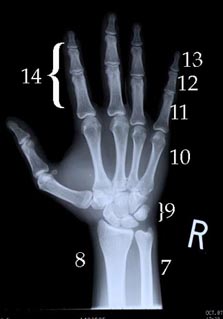
6. Complete Part B &C of the Lab Handout (see X-Rays below for Part C)
7. List the structures found on the bones of the pectoral girdle and arm (those listed above) and describe their individual functions; ie. specific articulation or muscle attachments
8. As you complete the lab, Review the "Lab Objectives" from the handout and write a synopsis of the lab addressing the two objectives.
| 14.1 | 14.2 | |||||||||||
|
|
|||||||||||
| 14.5 | ||||||||||||
| 14.4 | ||||||||||||
| 14.3 | |
|
||||||||||
|
||||||||||||
|
|
|||||||||||
|
||||||||||||