The Skeleton Project
Your task is to create a 'poster' of the human skeleton to that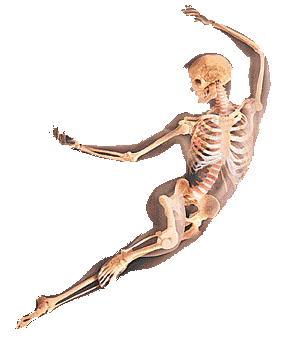 is to scale. You want to be as accurate as possible in both size and shape. The goal of this project is to help you learn the names of the bones as well as other common features of the human skeleton. Neatness is imperative, as is accuracy. You can be as creative as you like in composing your poster; you need not make a simple drawing in SAP. Labels should be clearly written. Any colorations or shading should also be done neatly. Below is a list of the items that are to be included. Please note that they are not all bones, but all are features of the human skeleton.
Bones: Include the following:
• All bones of the appendicular skeleton. Wrist and ankle bones may be referred to by their 'group' name, but make a note as to how many their are. Make a point to show calcaneus and talus.
• All bones of the axial skeleton. Name vertebrae both by their 'group' name (and number of) as well as by their abbreviated name, ie. T1, T2, etc. for the thoracic vertebrae. Add a side view so that all cervical, including atlas and axis, can be seen. Include an individual vertebrae to show it’s structure. Take time to show as many of the cranial and facial bones as possible (SLIGHT coloration of the bones may help). Also draw a lateral and inferior view so you can show ALL cranial features.
Joints: Although we have not formally addressed joints we will still examine them in this exercise. Use color to show the articular cartilage of each joint, BUT use specific colors for each joint type: Ball & socket, Pivot, Gliding, Hinge, Partial movable, Immovable (sutures). Place a "Key to Joints" on your poster somewhere. Remember that articular cartilage tends to be thin, with the notable exception of the vertebrae.
Major Landmarks: Processes and Depressions: include ALL the structures that we have examined in the labs (minimum of 38 structures), including but not limited to: Auditory meatus, Mental foramen and Foramen Magnum, Vertebral foramen, Spinous process, Foramina of the sacrum, Transverse process, Coracoid process, Acromion process, Glenoid cavity, Olecranon fossa and process, Iliac crest, Pubic symphysis, Greater and Lesser trochanter, any condyles, Lateral and Medial malleolus, and the Acetabulum.